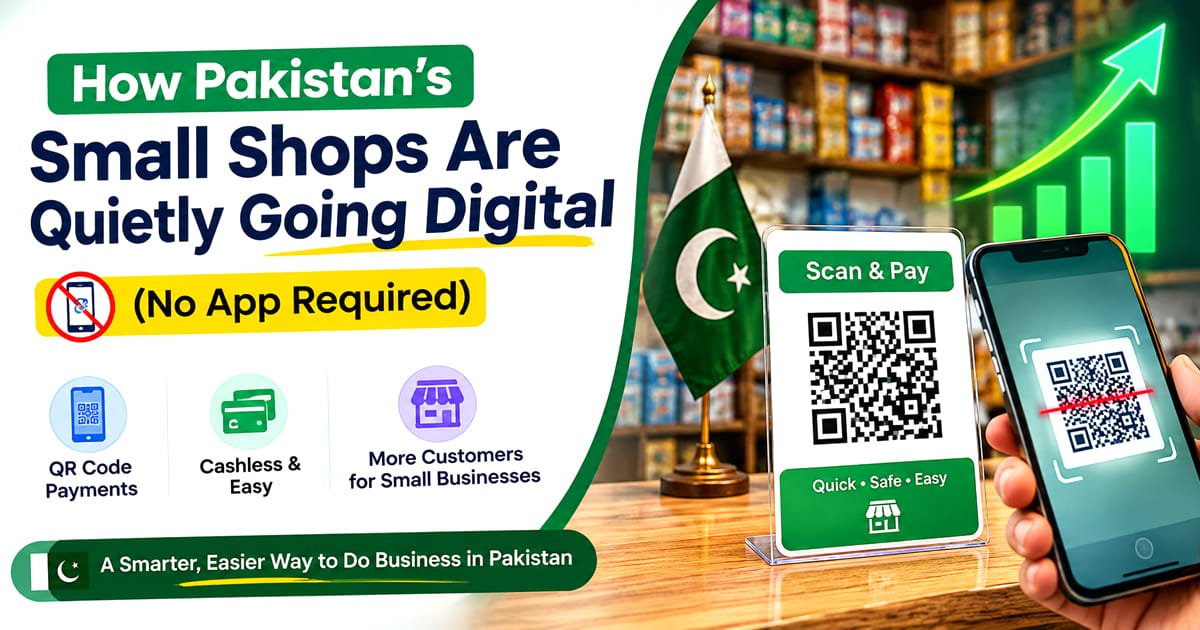
From roadside sabzi stalls to neighborhood tailors, small businesses across Pakistan are changing how they take payments and talk to customers and it's happening without anyone announcing it.
Walk through any bazaar in Lahore, Karachi, or Faisalabad this year, and you will notice something that wasn't there five years ago. Next to the cash box at the sabzi wala's stall. Taped to the counter of a mobile repair shop. Printed on a flyer outside a tailor shop. Small black and white squares, showing up everywhere, on everything.
Nobody announced this shift. There was no big campaign, no government push forcing shopkeepers to change how they work. It just happened one shop, one sticker, one customer at a time because it solved a problem people had stopped noticing was even a problem.
The Cash Habit Nobody Questioned
For as long as most of us can remember, small business in Pakistan ran almost entirely on cash. It worked, in the sense that the country entire informal economy was built on top of it. But it came with a list of small headaches that every shopkeeper just accepted as the cost of doing business counting notes at closing time, worrying about a fake five hundred slipping into the drawer, keeping enough change on hand for the first customer of the day, and the quiet, constant risk of having too much cash sitting in a till that anyone could walk up to.
Mobile wallets changed some of that. Easypaisa and JazzCash gave people a way to move money without carrying exact change, and adoption climbed fast because the alternative going to a bank branch was never realistic for most daily transactions. But even mobile transfers had friction built in. Reading account numbers aloud over a counter. Typing a long IBAN by hand while three people wait in line behind you. Getting one digit wrong and having to start over.
That's the exact friction a scannable code removes. A customer opens their payment app, points the camera at a small printed square, and the shop account details fill in automatically. No typing. No spelling out numbers. No queue building up behind a fumbled transaction.
Why Shopkeepers Didn't Need Convincing
What's genuinely interesting about this shift is how little persuasion it took. Shopkeepers in Pakistan are not, generally, early adopters of new technology for its own sake they adopt what saves time and money, and they ignore everything else. A printed code cost next to nothing to produce and put up. No monthly fee. No hardware to buy or charge. No training beyond customers point their phone here.
Compare that to a card machine, which needs a formal bank agreement, takes a cut on every transaction, and can break down or run out of battery at the worst moment. For a shop doing a few thousand rupees a day, that math never worked in the card machine favor. A sticker near the register does the same job of enabling a cashless sale, at effectively zero ongoing cost which is exactly why this spread faster through the informal retail sector than through some of the more official digital payment pushes that came before it.
It Stopped Being Just About Payments
When shopkeepers noticed customers were comfortable scanning something with their phone, other uses followed on their own. A tailor in Gulberg started printing a code on customer receipts that opens straight into a WhatsApp chat, so people could send measurements or check on an order without saving a new number. A small dhaba swapped its laminated, food stained menu card for a single scannable table tent, and now updates prices without reprinting anything. A furniture workshop put one on a business card that jumps directly into a WhatsApp conversation, skipping the step where a customer has to type out and save a stranger number just to ask is this still available.
None of these business owners would describe themselves as tech savvy. They did not hire a developer or pay for an app subscription. They noticed a simple, nearly free tool that solved one specific, everyday annoyance, and they used it the same way they'd start using a better broom if someone handed them one.
The Trust Problem That Came With It
This shift hasn't been without its own friction. As scannable payment codes became a normal sight at checkout counters, a smaller but real number of scam attempts followed fake stickers placed directly over genuine ones, quietly redirecting a customer payment to someone else account entirely. It's a real risk, and it's worth being deliberate about check that a code hasn't been tampered with or pasted over another one, and always confirm the receiving name shown on your payment app before you send money, not after.
This looks like a growing pain rather than a dead end. It's pushed a bit more awareness into how people actually look at these codes before scanning, and payment apps have started showing stronger confirmation screens with the verified receiver's name before a transaction goes through a fairly direct response to exactly this kind of scam.
Where This Is Actually Heading
What's happening in Pakistan's bazaars right now isn't a copy of what worked somewhere else. It's shaped by local habits, local apps, and what small business owners here actually need on an ordinary Tuesday not by a strategy document written in another country. A shopkeeper who never touched a computer can still put up a payment code today, because the only real requirement is a phone camera, not a course or a certificate.
The next stage is probably less about payments specifically and more about everything else a small shop needs to communicate with the people walking past it order updates, menus, catalogs, appointment slots, reviews. Each of those can, in principle, sit behind the same kind of scannable square that's already become a completely unremarkable part of buying vegetables or getting a shirt stitched.
It's easy to miss because none of it is flashy. Nobody throws a launch event for a sticker taped to a counter. But multiply that one small shop by the hundreds of thousands scattered across the country, and it adds up to something real a quiet, practical shift in how Pakistan's smallest businesses actually operate one scan, one sale, at a time.
Thinking about setting up a payment or contact code for your own shop? You can generate one for free in under a minute no app, no sign up required to get started.