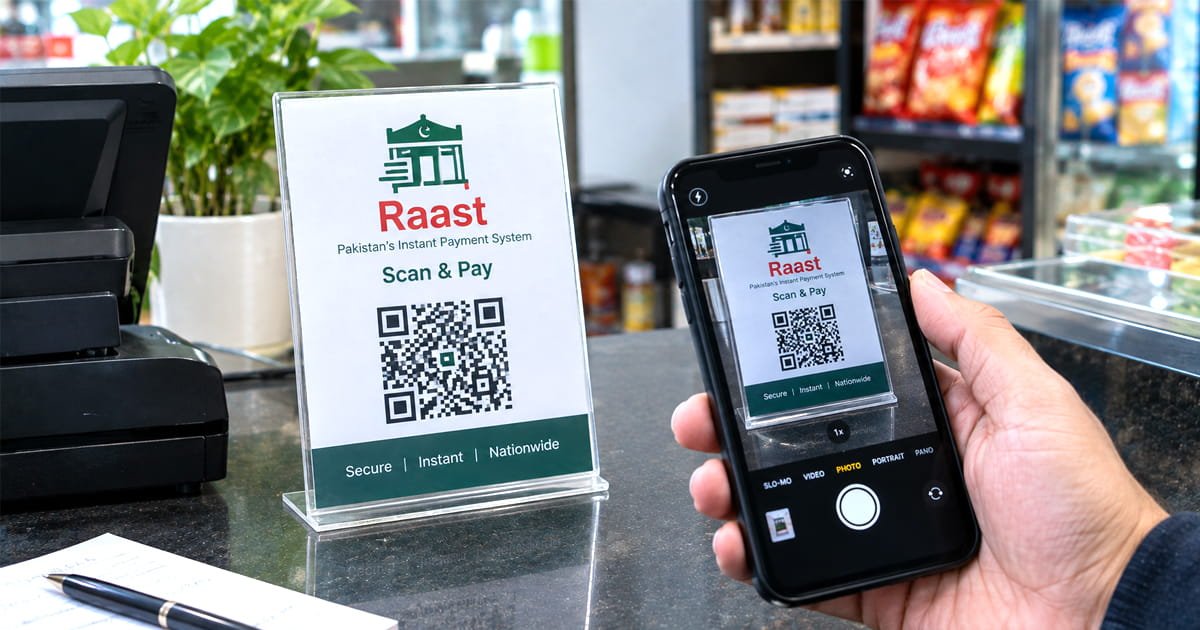
SBP has made Raast QR payments mandatory for Pakistani businesses in 2026. Here's the new interoperable standard, deadlines, and what shop owners need to do.
Walk into almost any shop in Pakistan today and you'll probably see two or three different QR code stickers taped near the counter one for the owner's JazzCash, one for Easypaisa, maybe a bank's own code. What most shop owners don't realize yet is that as of this month, the State Bank of Pakistan has quietly finished rolling out a rule that makes most of those separate stickers redundant, and turns having a QR code at all from a nice-to-have into a legal requirement.
How we actually got here
The QR code isn't new to Pakistan's payment system SBP issued the country's own Raast QR standard back in March 2022, covering both person-to-person and person-to-merchant payments through its Raast instant payment rail. What's changed is how hard the central bank has pushed adoption since, and how far it's gone in the last eight months alone:
- January 25, 2026 — Pakistan's Minister of State for Finance, Bilal Azhar Kiani, confirmed a draft amendment to the Payment Systems and Electronic Fund Transfers Act, 2007, mandating at least one digital payment option specifically including Raast QR codes at every retail business in the country.
- February 18, 2026 — Punjab didn't wait for the federal rollout. The provincial government directly ordered every business in the province to display a QR code and accept digital payment, with Deputy Commissioners assigned to oversee enforcement.
- August 3, 2026 — SBP issued a specific circular for fuel stations: every petrol pump nationwide has until January 31, 2027 to implement Raast QR payments, with the merchant fee on card payments capped at Rs 1 per litre.
- This month — SBP officially enforced the Unified Raast Person-to-Merchant (P2M) Interoperable QR Standard across every licensed commercial bank, microfinance bank, and electronic money institution in the country, while simultaneously activating the Buna cross-border bridge linking Raast to the Arab Monetary Fund's regional settlement network for instant remittances from the Gulf.
That last point is the one that actually changes what a shop owner experiences day to day, and it's worth explaining properly, because most coverage of this has buried it in policy language.
What "unified" and "interoperable" actually mean at the counter
Before this standard, Pakistan's QR payment landscape was genuinely fragmented a code generated through one bank or wallet often couldn't be reliably scanned and paid by a customer using a different bank's app, which is exactly why shopkeepers ended up taping up three or four separate codes side by side. The interoperable standard removes that requirement entirely: one correctly issued Raast QR code is now meant to accept payment from any participating bank, microfinance bank, or e-money institution's app, regardless of which one the customer or the merchant happens to use.
Alongside the interoperability mandate, SBP has also tightened the security backbone behind every dynamic QR code on the network, under its Technology Risk Management Framework. Two details worth knowing even as a non-technical shop owner, because they explain why your QR code might behave differently now: every dynamic checkout QR code generated by a billing system must now expire and refresh within 300 seconds to block replay-style fraud, and every connection between merchant apps, banks, and the central Raast gateway has to run on encrypted, mutually authenticated channels. In plain terms the code behind the counter is being treated less like a printed sticker and more like a live, time-limited transaction, which is also why a static, permanently-printed Raast QR code is being phased toward dynamic, app-generated versions for anything beyond a fixed small business.
Why the government is pushing this so hard
The scale of the problem SBP is trying to solve is enormous: an estimated 85% of transactions in Pakistan still happen in cash, a figure the central bank has explicitly tied to trillions of rupees lost every year to tax leakage, cash-handling costs, and idle liquidity sitting outside the banking system. To pull merchants across that line, the government isn't relying on enforcement alone a Rs 3.5 billion subsidy program running from September 2025 through June 2026 reimburses banks and payment institutions 0.5% of every P2M QR transaction's value (or Rs 100, whichever is lower), specifically to make onboarding effectively free for small merchants. SBP's own target is 15 billion Raast transactions by the end of December 2026, with a parallel push to build a centralized merchant database so subsidies and outreach can actually reach the roughly 2–3 million small businesses still outside the digital system entirely.
What this actually means if you run a shop, dhaba, or small business
A few practical things worth acting on rather than waiting to be told about:
- If you don't have a Raast QR code yet, get one from your own bank or the mobile wallet you already use — under the subsidy program, onboarding costs are minimal to zero for most small merchants right now, and that window has an end date.
- One compliant QR code should be enough going forward. If you're currently juggling separate codes for separate wallets, ask your bank whether your existing Raast QR is issued under the new interoperable standard if it is, you likely don't need the extra stickers anymore.
- Petrol stations specifically have a hard deadline — January 31, 2027 and the per-litre fee structure is already fixed by SBP circular, so there's no ambiguity to wait out.
- A printed static code isn't necessarily wrong, but it's increasingly the old version of this system. The direction SBP is pushing dynamic, time-limited, bank-issued codes is where enforcement is heading next.
One honest distinction worth making: the official Raast QR code itself has to come from your bank or a licensed payment institution under SBP's framework that's not something a general-purpose QR generator can issue, since it's tied directly to your merchant account and the interoperable payment rail. Where a tool like this one is genuinely useful is everything that sits around that official code: a dynamic QR linking to your digital menu, WhatsApp number, or feedback form, printed right next to your bank-issued Raast code at the till which is exactly the pattern we've already seen forming at Pakistani dhabas and small neighborhood shops as they've gone digital over the past year.
The sticker taped by your till used to be optional. As of this month, for most of the country, it effectively isn't anymore and the businesses that treat this as routine paperwork rather than a real deadline are the ones likely to be scrambling when enforcement catches up to the policy.