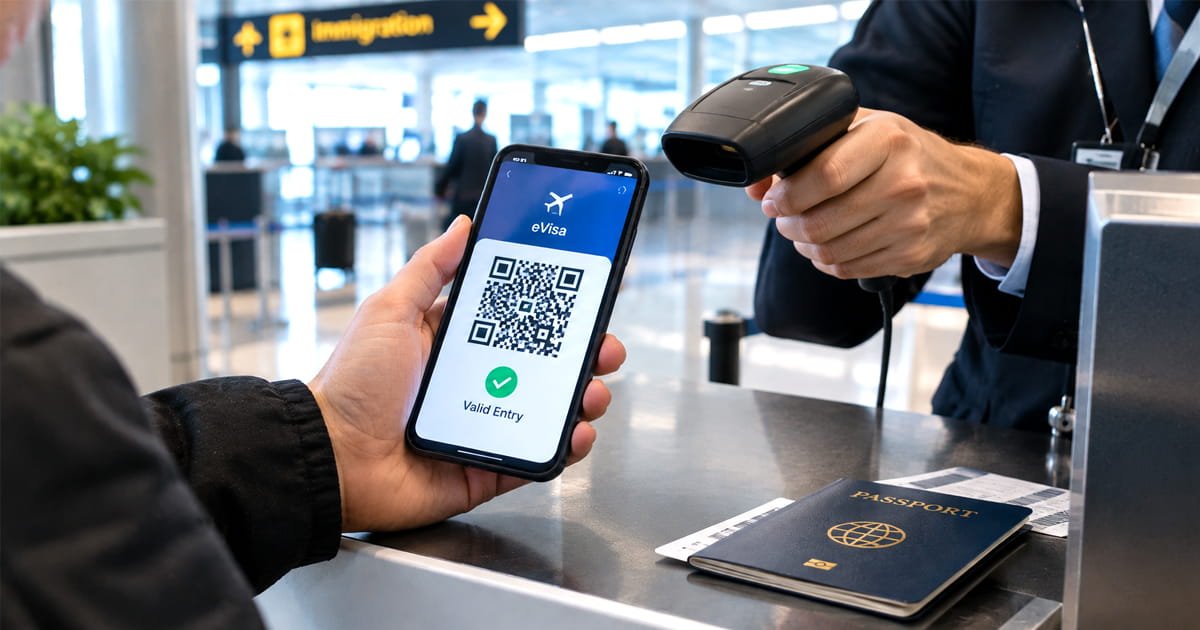
From Egypt to Thailand to the EU, over 30 countries quietly replaced paper visas and arrival cards with QR codes in 2026. Here's the pattern nobody's named yet.
Here's a pattern nobody's written about yet, even though every individual piece of it has already made headlines this year: right now, in 2026, entering another country is turning into the same action almost everywhere you go pull out your phone, open a code, let someone scan it. Not because one government copied another. Because more than thirty countries reached the same conclusion independently, in the same twelve-month window, and the sheer size of that coincidence is worth stopping on.
Look at what's actually happened just since January.
The pieces, laid side by side
Thailand made its Digital Arrival Card mandatory for every single foreign entry no more paper TM6 forms on the plane. Fill it in online, and immigration scans a QR code at the gate instead of stamping a passport.
Egypt started dismantling one of the oldest rituals in travel the paper visa sticker pasted into your passport at the airport counter. Since August 1, 2026, travelers landing at Cairo International can get a Visa QR Code instead, generated online or at a kiosk before they ever reach the immigration desk.
Singapore now requires every visitor to file an SG Arrival Card digitally within 72 hours of landing, replacing the paper disembarkation card that used to get handed out on the plane.
Australia, the UK, the US, New Zealand, South Korea, Sri Lanka, Kenya, and the entire European Union have all built or are actively finishing their own version of the same idea — an Electronic Travel Authorization that a traveler applies for before flying and that gets checked as a digital credential, often a QR code, at the border rather than a stamp in a passport book.
And the biggest piece of all is still moving: the EU's ETIAS system, covering more than 60 visa-exempt nationalities including the US, UK, Canada, and Australia, has been sitting at "confirmed for Q4 2026" in official EU communications for months. But as of mid-August 2026, at least one investigative report citing the EU's own IT agency, eu-LISA found that target has quietly been pulled from the official page after internal conclusions that a 2026 launch isn't realistic, pointing instead to sometime in 2027. Even the timeline for the world's biggest digital-entry rollout is proving hard to pin down, which tells you how fast this entire space is moving under the surface.
Separately, in ASEAN, Malaysia's DuitNow QR payment network has spent the last few years linking up with Thailand, Singapore, Indonesia, and Cambodia so a QR code scanned at a market stall settles in the local currency automatically the payment version of the exact same shift happening at the border.
None of these projects talk to each other. That's what makes it interesting.
Egypt's Ministry of Tourism didn't coordinate with Thailand's immigration bureau. Singapore's Arrival Card team isn't reporting to Brussels. These are separate governments, separate IT contractors, separate budgets, solving what each of them frames as a local problem airport congestion, paper processing costs, security screening speed. And they've all landed on the same tool: a piece of technology that costs almost nothing to generate, works on any phone camera without an app, and can carry more information than a human border officer can read at a glance.
That's the real story here, and it's one that gets lost when each rollout is covered as an isolated news item. It isn't "Egypt adopts a QR visa" or "Thailand mandates a digital card." It's that the QR code a format most people associate with restaurant menus and marketing flyers has quietly become the default data-transfer layer for international borders, on every populated continent, in the same calendar year.
What this means if you're actually booking a trip in the next 12 months
A few things worth sitting with before your next international flight:
- "Visa-free" doesn't mean paperwork-free anymore. Dozens of countries that never required a visa for your passport now require a pre-arrival digital authorization anyway — Thailand's TDAC and the EU's incoming ETIAS both apply even to travelers who've never needed a visa for those destinations before.
- The QR code is usually generated well before you fly, not at the airport. Egypt's system allows requests up to 48 hours ahead; Thailand's TDAC has to be filed before boarding; ETIAS, once live, will require applying days or weeks in advance. The habit of sorting entry paperwork at the border is fading fast.
- A screenshot isn't always enough. Multiple systems specifically warn travelers to keep a downloaded or printed backup rather than relying on a live app screen, in case of a dead battery or unreliable signal right when it matters most.
- Fake versions are already a real risk. Several official trackers for ETIAS explicitly warn that unofficial sites are already selling fraudulent "applications" for a system that isn't even live yet — a scam pattern worth watching for with any of these QR-based entry systems, not just Europe's.
The bigger shift underneath all of it
What's really happening is that the QR code has moved from being a marketing convenience to being trusted with identity-level stakes the thing standing between you and a border, not just between a diner and a wine list. That's a meaningful jump in what these codes are expected to hold and protect, and it's happening at the same time businesses are leaning on the exact same technology for their own identity and contact-sharing needs a vCard QR code on a business card, an event QR code at check-in, a dynamic link that can be updated after it's already printed. The underlying format hasn't changed. What's changed is how much the world has decided to trust it with.
We covered Egypt's own version of this shift in detail here but Egypt turns out to be one data point in a much bigger picture that's been building all year, mostly one country announcement at a time, with nobody stepping back to count how many there now are.