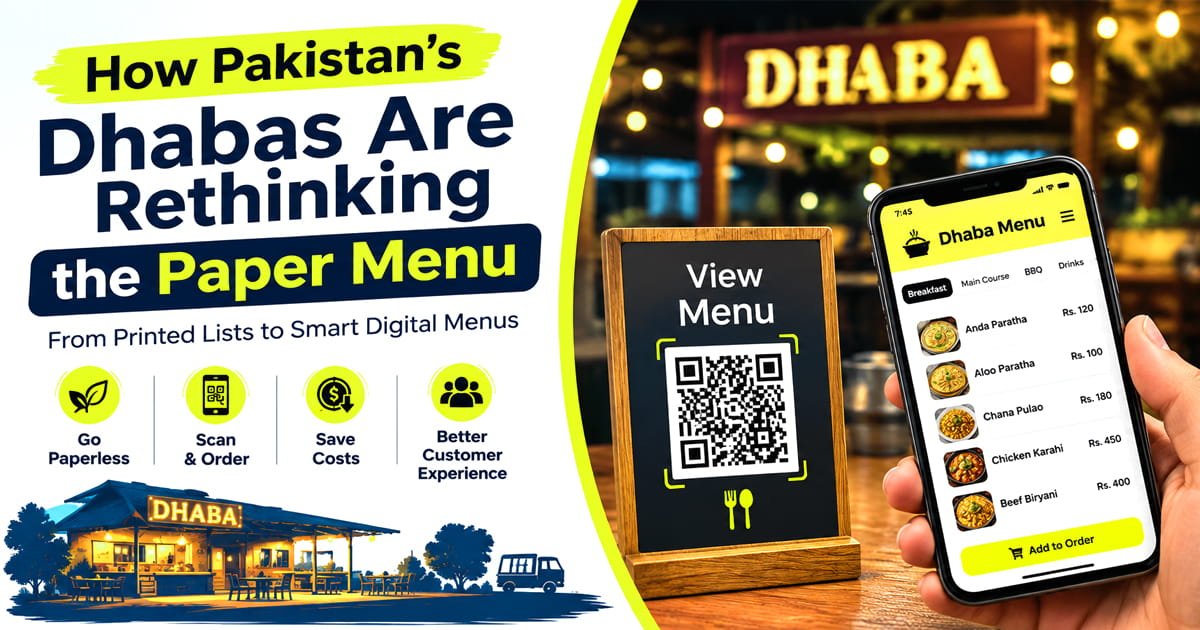
The laminated, sauce-stained menu card has been a fixture of Pakistani dhabas for decades. A quiet shift is changing how some of them handle prices, language, and hygiene without touching what makes a dhaba a dhaba.
Every dhaba has the same menu card. Laminated, slightly curling at the corners, with a faint outline of a dal stain that's been there longer than the current waiter. Someone wrote the prices in marker a few years ago, then crossed one out and wrote a new number above it when chicken got expensive, then did it again a year later. By now the card has more corrections than original print.
This isn't a complaint about dhabas the card works, and nobody genuinely bothered by it. But in a growing number of small eateries, from roadside tandoors to family run karahi spots, that same laminated card now sits next to a small printed square. Scan it, and the same menu opens on your phone, except this version has today's actual prices.
The Real Problem Wasn't the Menu It Was Updating It
Printing a menu card in Pakistan isn't expensive, but it isn't free either, and for a dhaba running on thin margins, reprinting fifteen laminated cards every time mutton prices jump is a cost most owners just absorb by scratching out old numbers instead. The result is a menu that's technically accurate if you know which crossed out price to ignore, which is fine for regulars and confusing for anyone new.
A scannable menu removes that entirely. The owner updates one page, and every table code points to the same current version. No reprinting, no marker corrections, no guest asking the waiter "yeh price sahi hai ya wo purana wala." For a dhaba that changes its rate list seasonally cheaper in winter when vegetables are in season, pricier around Eid when demand spikes this alone solves a recurring, mildly annoying cost.
The Language Problem Nobody Designed For
Most dhaba menus are handwritten or printed in a mix of Urdu and rough English, often by whoever was available to write it, not a designer. That works fine for the regular crowd but breaks down the moment a customer who reads only English, or only Urdu, walks in and has to guess what "special" means on an unlabeled dish.
A digital menu behind a code can quietly solve this without redesigning the physical card at all. Some smaller places have started linking to a version with both languages side by side, or even just clearer item names, since typing that out digitally costs nothing extra once it exists unlike squeezing a second language onto an already crowded laminated card.
Where This Fits Into a Bigger Shift
This isn't happening in isolation. It is part of the same broader pattern already showing up in how small businesses across Pakistan are handling payments a shopkeeper who's already comfortable with customers scanning something to pay naturally extends that same habit to the menu, since the underlying skill (point phone, scan, done) is identical either way.
Setting one up does not require anything technical either. An owner or a tech comfortable family member can generate a QR code for a menu link in a couple of minutes, print it once on a small card or sticker, and the rest of the setup is exactly the same as before someone hands you a menu, except now it never goes out of date.
The Hygiene Angle That Stuck Around
A shared, laminated menu that's been touched by hundreds of hands and occasionally wiped down with the same cloth used on the table isn't something most people think about until they do. That awareness did not disappear once it became less of a talking point, and some dhaba owners have simply kept the scannable option going because a few regular customers genuinely prefer not to touch a shared card, particularly the older laminated ones that rarely get properly cleaned.
It's a minor factor next to cost and language, but it's part of why a handful of places kept the code even after treating it as a temporary fix.
What Hasn't Changed, and Won't
None of this touches what actually makes a dhaba work. The karahi is still cooked the same way, the seating is still plastic chairs and a shared table if it's busy, and the laminated card usually stays too most owners aren't removing it, just adding an option next to it for anyone who did rather check prices on their phone before ordering. Regulars mostly ignore the code entirely and order the same thing they always do from memory, which is exactly as it should be.
What's changed is smaller and more practical than it sounds a dhaba owner no longer needs to choose between an outdated price and an expensive reprint, and a first time customer no longer has to guess whether the crossed out number or the one above it is current. It's not a transformation. It's one annoying, recurring problem quietly handled while everything else about the dhaba stays exactly the way regulars want it to.
Want to set up a digital menu for your own dhaba or small eatery? You can create a QR code linking to your menu for free, no design skills or sign-up needed.