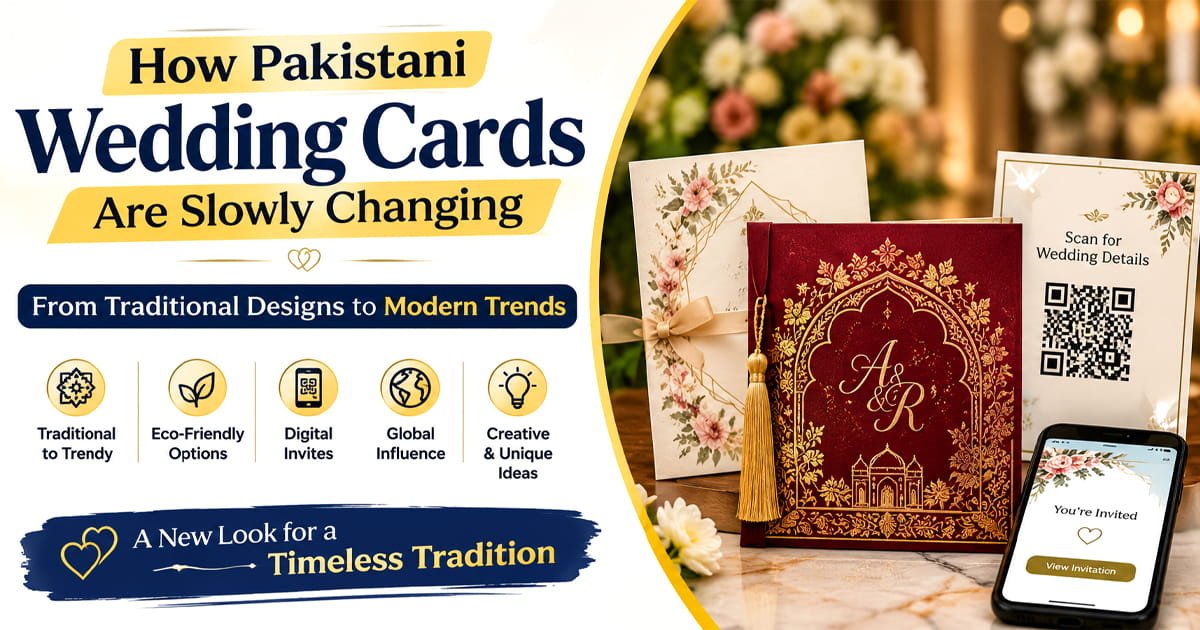
From gold-embossed invitations to a small printed square in the corner, wedding cards across Pakistan are quietly picking up a digital habit and it's solving problems families have dealt with for generations.
Every wedding season in Pakistan brings the same familiar routine. Cards get designed, printed, and hand-delivered or couriered to relatives in three different cities. Someone phuppo calls to ask if the venue changed. A cousin abroad messages asking for the address again because they lost the card. And on the day itself, someone at the gate is still trying to figure out who is actually invited and who just showed up with a distant relative.
None of that has really changed in decades. But if you look closely at cards being printed this year, something small has started showing up in the corner, near the venue details or under the RSVP line: a tiny black-and-white square.
It's not replacing the card. It's just quietly making it more useful.
The Problem Every Wedding Card Has
A printed card can only hold so much. Families spend weeks getting the wording right, deciding whose names go where, choosing between Urdu and English, and picking a design that looks appropriately grand and by the time all of that is settled, there is barely room left for the practical details that guests actually need on the day.
Where exactly is the venue, and does the pin on Google Maps match the address printed on the card? Is there a separate hall for mehndi and walima? What time does the actual nikah happen versus when dinner is served? Is there parking, or should guests expect to walk from a nearby lot? These are the questions that flood the groom's or bride's phone for two weeks straight, one relative at a time, often at midnight.
A code printed on the card sidesteps all of that. Point a phone camera at it, and it can drop a guest straight into the exact map location, skip the confusion of a written address that autocorrect mangled somewhere along the way. Some families use it to link a short video invitation, since more people now expect that personal touch instead of, or alongside, the printed card. Others use it purely for logistics one scan, and a guest has the full day's schedule instead of a single printed time that never quite matched reality anyway.
Why This Fits Pakistani Weddings Specifically
Weddings here are rarely a single event. There is mehndi, baraat, walima, sometimes a separate dholki or walima at a different venue entirely, spread across days and sometimes across cities when families are inviting people from both sides of the world. Printing all of that clearly on one card, in a way that doesn't look cluttered, is genuinely difficult.
Most families end up choosing elegance over completeness, and the details get communicated separately through a family WhatsApp group, a phone call, or word of mouth that inevitably gets something wrong by the third relay. A single scannable code solves this without touching the card design at all. The card stays exactly as ornate and traditional as the family wants it, gold foil and all, while the square in the corner quietly carries everything that wouldn't otherwise fit multiple venue links, a day by day schedule, a contact number for the wedding coordinator, sometimes even a dress code note that saves the bride from fifteen individual phone calls asking "kya pehnna hai."
There is also a very Pakistani specific use worth mentioning overseas relatives. A card physically mailed abroad often arrives crumpled, delayed, or occasionally lost in transit entirely. But a WhatsApp forward with a photo of the card, code included, works instantly no matter where in the world it lands. The relative in Toronto scans the same code as the aunt three streets away, and both end up with identical, accurate information.
It's Not Really About the Technology
What is worth noticing is that none of the families doing this think of themselves as adopting "technology." Nobody's hiring anyone or learning a new skill. A cousin who is reasonably comfortable with a phone generates the code in a few minutes, hands the file to whoever's designing the card, and that's the entire technical involvement. The card printer places it wherever it fits, usually near the bottom corner, and the rest of the process is identical to how it's always been.
This mirrors something already happening elsewhere in how people share contact and event details more broadly the same underlying idea used for sharing a contact card digitally shows up here in a slightly different form, just adapted for a hall full of relatives instead of a business meeting.
A Small Practical Note
Since these cards often get shared widely forwarded in family groups, posted casually, sometimes even shared on social media by an excited cousin it's worth keeping the code itself pointed at something non sensitive. A map link or an event page is fine to share broadly. Anything involving direct payment details, like gift or wedding fund contributions, is better handled separately and shared more privately, since a card photo can end up circulating further than anyone intended.
Where This Is Going
This isn't going to replace the card itself, and nobody really wants it to. There is a reason families still spend on embossed lettering and heavyweight paper for something that guests keep as a keepsake long after the wedding. The scannable code isn't competing with tradition it's sitting quietly next to it, handling the one job a beautifully designed card was never built to do carrying a lot of practical, changeable information without cluttering the design.
Next wedding season, expect to see more of these small squares tucked into card corners, silently answering the same "kahan hai venue" questions that used to take three phone calls and a confused uncle to resolve.
Planning to add one to your own wedding cards? You can create an event QR code for free in a couple of minutes — no design skills or sign-up needed to get started.