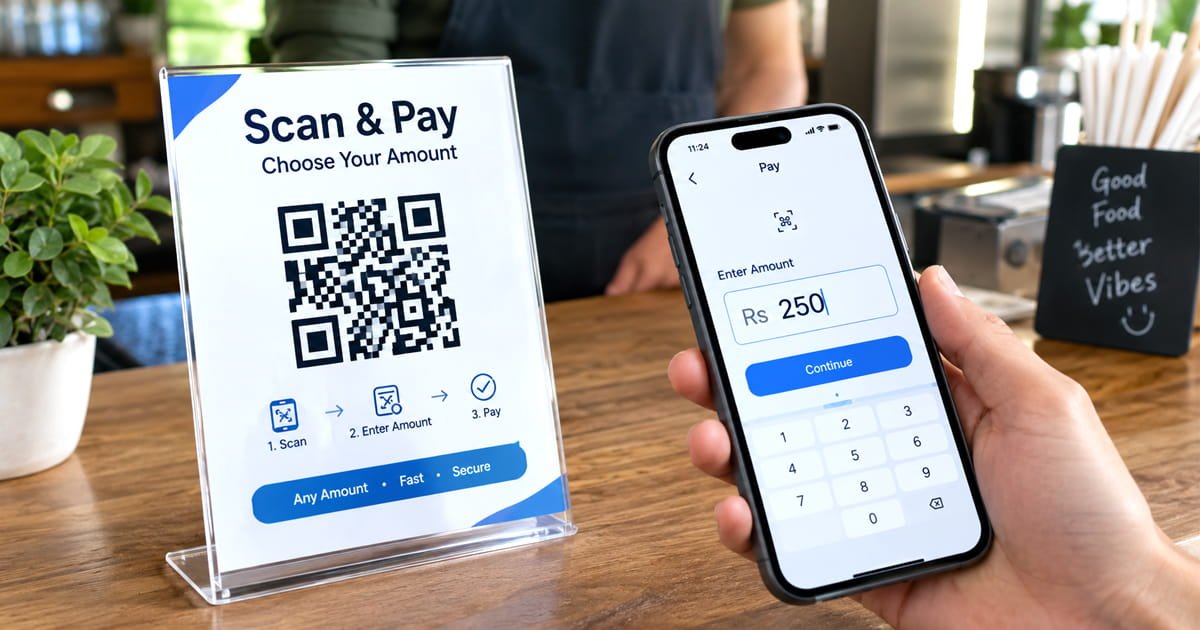
A UK payments company just launched a QR code built specifically for tips and donations, where the customer decides the amount instead of a fixed price. Here's why that's a bigger gap than it sounds.
Most QR payment codes we've written about work the same basic way scan, and a fixed amount gets paid a bill, an invoice, a product price. Earlier this month, a London-based payments company called Ecommpay launched something built for the opposite situation: a QR code where nobody's decided the amount in advance, because the whole point is that the customer does.
Think about the moments this actually covers. A waiter gets a good tip, but the table paid by card and nobody's carrying cash. A charity collection bucket goes around, but half the room only has Apple Pay. A kid runs a lemonade stand and someone wants to pay more than the sign says because it's hot outside and the lemonade is good. None of these have a fixed price. They all rely on someone deciding, in the moment, how much to give.
Why this gap actually exists
Cash used to handle all of this without anyone thinking about it you throw in a coin, drop a note, hand over whatever you've got. As fewer people carry physical money day to day, that entire category of spontaneous, variable payment has been quietly disappearing, not because people don't want to tip or donate, but because the easiest way to do it stopped being in their pocket.
Card machines and standard payment links don't really solve this either, since they're built around one party setting a price and the other agreeing to pay it. A tip jar doesn't have a price. Neither does a donation bucket. Ecommpay's new QR code is specifically designed to sit in that gap one static code, displayed once, that lets whoever scans it either enter their own amount or pick from a few preset options the merchant defines.
How it's actually set up
The part worth paying attention to is how little technical effort this takes on the merchant's side. According to the company, the whole thing gets created and managed from a dashboard no developer, no integration work, no separate hardware. A restaurant, a market stall, or a small charity can generate one QR code, print it once, and reuse the exact same code indefinitely until they choose to deactivate it.
The merchant gets to decide the format too strictly a custom amount, a set of preset options like £2 / £5 / £10, or a mix of both. Whoever scans it lands on a branded payment page the merchant's own logo and colours, not a generic checkout screen enters or picks an amount, and pays however they'd normally pay online.
Where this actually gets useful
The obvious use case is restaurant tipping, and it's a real one a QR code taped near the till or printed on the receipt gives a card-only customer an actual way to tip that doesn't involve awkwardly asking if the card machine "does tips." But the more interesting cases are the ones without a card machine at all: a pay-what-you-can yoga class in a park, a stall at a school fair, a busker's case, a food bank collection point. These are situations where setting up full card payment infrastructure was never worth it, but a printed square that already exists costs nothing extra to make useful.
It's a similar idea to what we've seen elsewhere with QR codes replacing informal cash systems the same underlying shift we've written about with small shops taking digital payments, just applied to the specific case of amounts nobody's fixed in advance.
The part that's easy to miss
What's actually clever here isn't the QR code itself it's that the code stays exactly the same over time. A merchant doesn't need to generate a new code for every event or every shift. The same printed sticker on a tip jar keeps working for as long as the business wants it to, and all the actual control turning it on or off, changing the branding, adjusting the preset amounts happens on the back end without touching the physical code at all.
That's a small detail, but it's the difference between something a small business owner or a volunteer running a bake sale can realistically manage themselves, versus something that needs a developer every time circumstances change.
Setting one up yourself
You don't need this specific platform to build something similar for a simple case. A QR code pointing to any payment link that already supports a customer-entered amount — a UPI or PayPal-based QR code, for instance covers a lot of the same ground for smaller, informal situations where a full merchant dashboard is more than you need.
Cash isn't coming back as the default, and the awkward "sorry, I don't have my wallet" moment at a tip jar or donation bucket isn't going away on its own either. What's changing is that there's finally a version of the QR code built specifically for the transactions that were never going to have a fixed price to begin with.
Want to set up a flexible payment code of your own? You can create a QR code for free in a couple of minutes, no development work required.