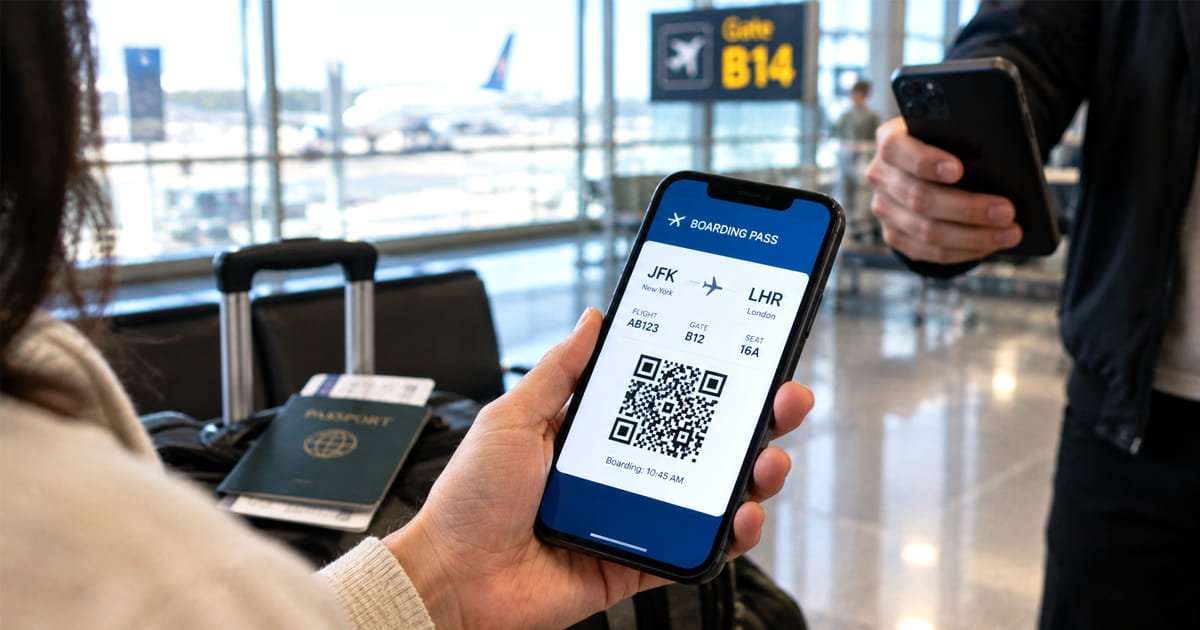
A researcher found Frontier Airlines' boarding pass QR code could expose passport numbers and home addresses still unpatched months later. Here's how to stay safe.
You board the flight, snap a photo of your boarding pass for the memory or the expenses folder, maybe let a corner of it slip into a travel story on Instagram. Harmless, right? It's just a name and a gate number.
Except that little black-and-white square in the corner is carrying a lot more than your name and gate number. And this year, a security researcher proved exactly how much more on a major US airline, in a way that's still not fixed months later.
What actually got found
Earlier in 2026, a researcher going by BobDaHacker dug up a serious flaw in Frontier Airlines' booking system. The problem, stripped down: with nothing more than a six-character booking code the PNR, printed right there on every boarding pass and a passenger's last name, anyone could pull a full internal booking record straight through the airline's own mobile API. Not just flight details, either. Full home address. Email. Phone number. Complete date of birth, including for kids traveling on the same booking. Unmasked passport numbers, issuing country and all.
The researcher did this the right way reported it to Frontier on March 3, 2026, followed up over the following months, gave the standard 30-day disclosure window that quietly expired on June 12 with no response. Findings went public June 18. Still live at the time of disclosure. Frontier's acknowledgment, per the report, was a model airplane mailed to the researcher. The actual bug? Not fixed.
Sit with that for a second. A PNR code and a surname both printed in plain sight on the boarding pass you just photographed, or that slipped out of your pocket at the gate, or got left folded in a seatback pocket were enough to pull a total stranger's passport number.
Not a one-airline problem. Not even new, really.
What makes Frontier worth writing about isn't that it's some freak one-off. It's that it's a fresh, concrete example of something much older that most travelers still haven't quite absorbed. Back in 2019, researchers found a similar flaw sitting inside Amadeus the reservation platform behind more than 140 airlines worldwide. Not one carrier's sloppy code. Shared infrastructure, holding a huge chunk of the whole industry.
And even without a system-level bug like Frontier's or Amadeus's, the boarding pass barcode has always carried more than what's printed in plain English on the card. Boarding passes follow a standardized format IATA Resolution 792 that packs in your name, flight details, seat, sequence number, and critically, your booking reference and frequent flyer number, all readable by any generic barcode-scanning app. Not just airline equipment. Security researcher Brian Krebs was documenting exactly this back in the mid-2010s, showing how one photo of a boarding pass posted to social media let him pull a stranger's entire itinerary and account access using nothing more than a free online barcode reader. A decade on, the exposure hasn't really changed. Mobile passes carry the same data as paper ones. A clear screenshot reads just as easily as the printed original.
Why does this keep happening?
Honestly? Boarding pass barcodes were never built with privacy as the priority. They were built for speed and interoperability. A gate agent's scanner needs to instantly confirm three things booking's valid, passenger cleared security, flight hasn't already boarded and doing that identically across every airline and every airport on earth meant standardizing the data format decades before "don't overshare on social media" was a concept anyone in airline IT was thinking about.
The bigger structural shift now underway biometric boarding, where you walk up, a camera checks your face, you walk through, no scan at all is partly a response to exactly this weakness. More than 250 US airports have some form of digital ID program running already, with roughly half expected to have biometric systems live by the end of 2026. But that's still the exception at most gates, not the rule. Which means the QR or barcode boarding pass stays the universal fallback pretty much everywhere you fly, for now.
What a stolen PNR and name can actually get someone
Worth being concrete here rather than waving at vague "identity theft" language. With a booking reference and your name, someone can usually log straight into the airline's "manage my booking" portal as if they were you no password needed, because the PNR basically is the password in most airline systems. From there: your full contact details, your frequent flyer number and status, and in some documented cases, actually changing or cancelling the return leg of your own trip. Add a Frontier-style vulnerability on top and it goes further still passport numbers, home addresses, exactly the kind of data that fuels account takeover fraud well beyond the airline itself.
So what do you actually do about it?
A handful of habits worth picking up, Frontier flyer or not:
- Never post a clear photo of your boarding pass anywhere public. Not even after the trip's done. Not even with the seat number blurred the barcode carries your name and PNR no matter what text you've cropped out.
- Shred paper boarding passes once you land, rather than leaving them in a bag pocket, a glovebox, or a hotel bin for someone else to find and scan later.
- Treat your digital boarding pass file like you'd treat a photo of your bank card. Don't leave it sitting in an unlocked gallery, don't forward it over some random unsecured channel unless you actually need to.
- Whatever airline you fly, remember your booking reference alone often functions as your full login. Treating it like a password, not a throwaway code, is a reasonable habit regardless of carrier.
- Shared a boarding pass photo in the past? Worth changing that frequent flyer password, especially if there's a stored card on the account.
The pattern underneath all of this
This fits a shape we keep bumping into on this blog a QR or barcode often holds a lot more than the plain text sitting right next to it, and that gap between what a code looks like it contains and what it actually contains is exactly where the risk lives. Same gap behind the QR code parking scams the FTC warned about. Same underlying habits covered in our guide to QR code phishing and scams. A boarding pass isn't some malicious code tricking you into scanning it it's almost the opposite problem. A perfectly legitimate code, just carrying far more than most travelers ever think to ask about.
Next time you're tempted to post that "off on holiday!" photo with the boarding pass in frame, costs you nothing to crop the barcode out. The data it's holding isn't going anywhere. And neither, months later, is the vulnerability that let one researcher pull passport numbers out of it using nothing but a surname and a six-character code.