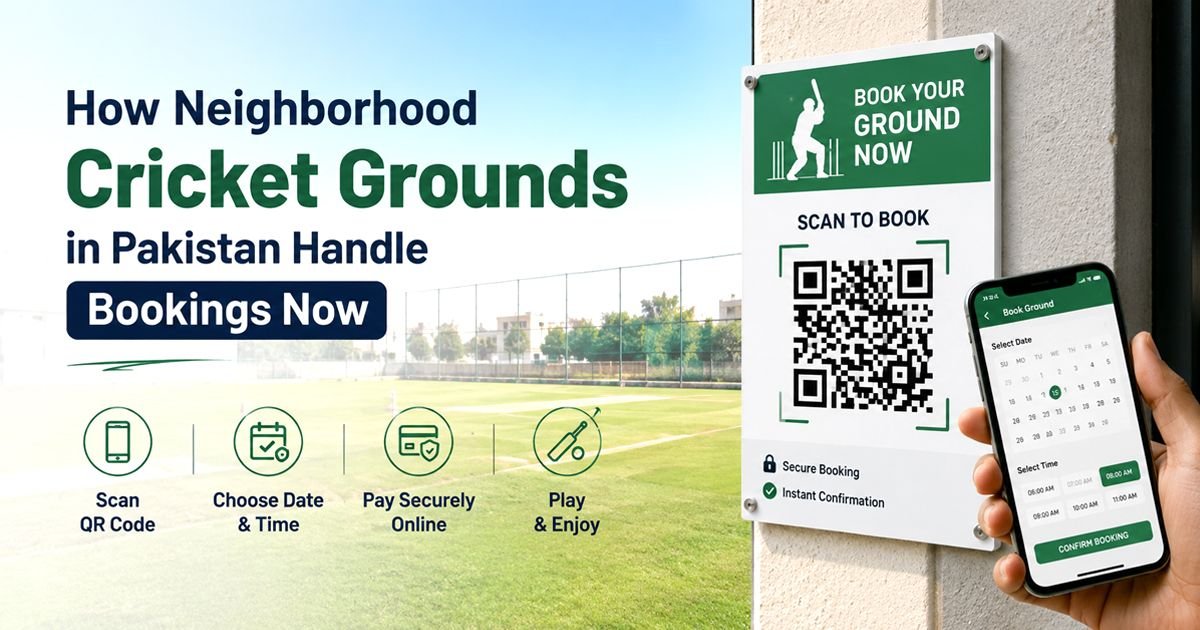
Every mohalla has a turf or tape-ball ground booked out most evenings. The old system of calling the ground owner and hoping he remembers your slot is slowly being replaced by something simpler.
Almost every mohalla in Pakistan has one. A small tape-ball ground or indoor turf, usually run by one guy who owns it or manages it for someone who does, booked out most evenings by local teams playing after Maghrib under floodlights. Booking a slot has traditionally meant one thing calling the ground owner directly, describing which evening and which hour you want, and hoping he actually wrote it down somewhere instead of trying to remember it along with everyone else booking that week.
This system mostly works, in the way that a lot of things in Pakistan mostly work through familiarity and repetition rather than anything formal. But it breaks in a specific, recurring way that anyone who's organized a match knows well.
The Double-Booking Problem
A ground owner juggling ten or fifteen regular teams, plus one-off bookings from people organizing a friendly match or a small tournament, is relying entirely on memory or a notebook to avoid two teams showing up for the same slot. It happens more often than it should two teams arrive at 7 PM, both convinced they did booked the ground, and now someone has to lose the argument or split the time in half.
The usual fix has been calling ahead the same day to confirm, which just adds a second phone call to a process that already required one. It works, but it depends entirely on the ground owner picking up, remembering correctly, and not being mid-conversation with someone else booking a different slot at the exact same moment.
What a Handful of Grounds Have Started Doing
A few grounds, mostly the ones that also run small tape-ball tournaments and need to manage this at a larger scale, have started keeping a simple shared schedule a page showing which slots are open for the week, updated whenever someone books or cancels. Instead of relying on a phone call that may or may not get through, a team can check the schedule directly and see real availability before calling to confirm.
The part that makes this practical for a ground that is not run by anyone particularly technical is how people reach that schedule. A code posted at the entrance, or shared in the team's WhatsApp group by the ground owner, links straight to the current week's slots. A URL-based QR code works fine here, since the page behind it just needs updating whenever a booking changes the printed code itself never has to be reprinted.
For tournaments specifically, some organizers have started using a code to link to the fixture list and scorecard as matches happen through the day, so players and spectators waiting for their turn don't have to keep asking "abhi konsa match chal raha hai" every twenty minutes. It replaces a hand-written fixture sheet taped to a pole, which usually gets outdated the moment the first match runs late.
Why This Fits Better Than a Full Booking App
Several booking apps exist for sports facilities generally, but most neighborhood grounds never adopt them, because a full app means downloads, accounts, and a level of formality that does not match how these grounds actually get booked through familiarity, WhatsApp groups, and a ground owner who knows most of his regular customers by name already.
A shared schedule behind a simple code does not ask for any of that. There's no account to create, no app to download, nothing to learn beyond scanning something and looking at a page. It fits into the existing system rather than replacing it the phone call to the ground owner still happens, it's just backed up by something both sides can actually check instead of relying purely on memory.
Where It Doesn't Help
A ground booked by the same three or four regular teams on a fixed weekly rotation does not need this at all everyone already knows their slot, and adding a digital schedule solves a problem that does not exist for them. This is specifically useful for grounds juggling enough one-off bookings and tournament traffic that memory alone starts producing the kind of double-booking argument nobody wants at 7 PM on a Friday.
It also only works if someone actually keeps the schedule updated. A code linking to a page showing last week's availability is worse than no system, since a team could easily crash into an already-booked slot after checking on outdated information.
A Small Fix for an Old Argument
None of this changes what happens on the ground itself the same floodlights, the same tape ball, the same arguments over whether that catch actually carried. What's changed for a few grounds is narrower the "maine pehle book kiya tha" argument at the gate has one less excuse to happen, because the schedule exists somewhere both teams could have checked before showing up.
Manage a ground or organize local tournaments? You can create a QR code linking to your booking schedule or live fixtures for free, no app or technical setup required.