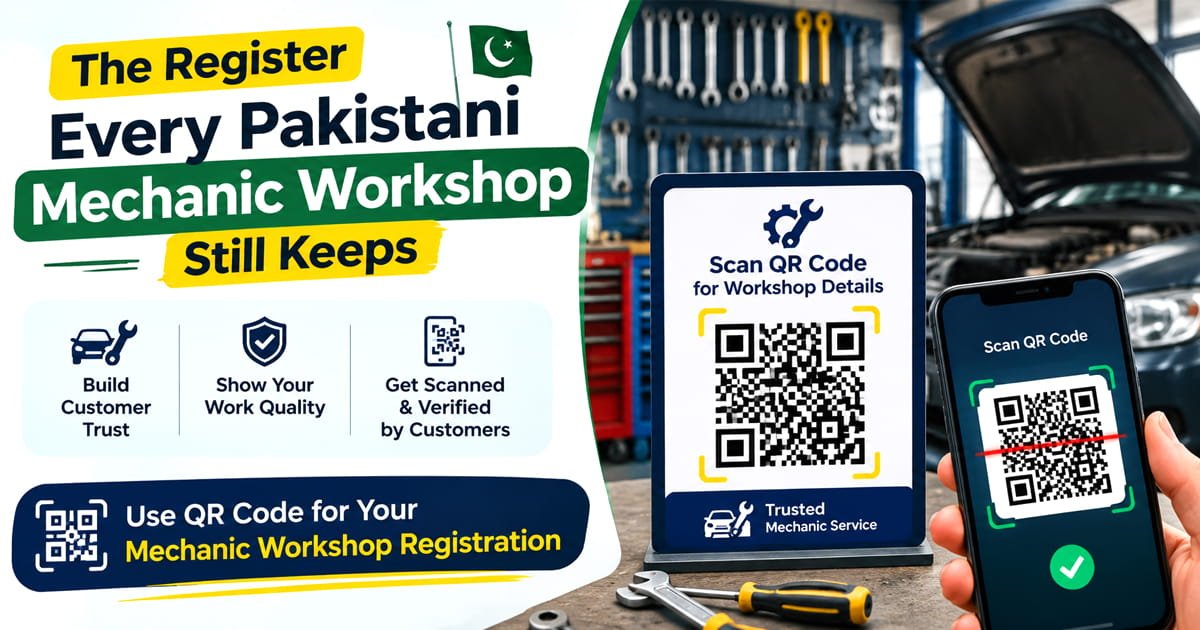
Ask a customer when their bike was last serviced and most workshops still flip through a handwritten register to find out. A few have started keeping that record somewhere a customer can check themselves.
Most motorcycle and car workshops in Pakistan run on the same system they've used for decades a thick register at the counter, where every job gets written down by hand. Customer name, bike number, what was done, what parts went in, and the date. When someone comes back six months later and says "pichli baar kya hua tha," the mechanic or the owner flips back through pages until they find the entry.
It works in the sense that the information exists somewhere. But it only works as long as the register itself survives, the handwriting is legible, and someone remembers roughly which month to look under. None of those are guaranteed.
What Actually Goes Wrong With a Paper Register
A workshop register has a single point of failure it is one physical object. If it gets misplaced, water damaged during monsoon season, or simply filled up and replaced with a new one that does not carry old entries forward, that history is effectively gone. A customer who switches mechanics, or whose regular workshop closes down, loses access to their own service record entirely, since it was never really theirs to keep it lived in someone else book.
There is a second, quieter problem. Two mechanics working the same shift often write in different registers, or the same register but inconsistently, which means a full picture of a vehicle history sometimes does not exist in one place at all. It's split across whichever worker happened to handle each visit.
The Version Some Workshops Have Started Using
A small number of workshops, mostly ones already comfortable taking payments through Easypaisa or JazzCash, have started keeping a digital version of the same register a simple page or spreadsheet listing service dates, parts replaced, and mileage at each visit, tied to a customer bike or car number. Instead of relying on the customer to remember which workshop they last visited, the record travels with them.
The part that makes this practical rather than just theoretical is how customers reach it. A code stuck onto the customer fuel tank, dashboard, or given on a printed slip after service can link straight to that vehicle's record. Next visit, any mechanic not necessarily the same one can scan it and see exactly what was done last time, what's due next, and whether a part still has warranty attached to it. A URL-based QR code works fine for this, since it just needs to point to a page that gets updated after each visit.
This mirrors something already happening in how small shops across Pakistan handle digital payments the same comfort with scanning something on a phone extends naturally into other parts of running a small business, once it's already normal for taking payment.
Why This Matters More for Bikes Than It Sounds
Motorcycles change hands constantly in Pakistan sold secondhand, passed within a family, or bought used from a dealer with no service history attached at all. A buyer picking up a used bike has genuinely no way to verify how well it was maintained unless the previous owner happens to remember and mentions it. A workshop linked record, even a basic one, gives a new owner something to check was the oil changed recently, is a part under warranty, what's the general service pattern been.
For a workshop, this becomes a small point of difference. A customer choosing between two mechanics for the first time has no way to judge either one on service quality alone but a workshop that can pull up an actual maintenance history on request looks more organized than one flipping through a damp notebook.
Where This Doesn't Make Sense
This is not a fix every workshop needs. A one man operation doing a handful of jobs a day, where the mechanic personally remembers most regular customers anyway, does not gain much from digitizing a system that already works through memory and a small book. The workshops where this genuinely helps are the ones handling enough volume that memory alone stops being reliable, or ones dealing with a customer base that doesn't return often enough for a face to be recognized on sight.
It also depends entirely on the workshop keeping the record updated. A code that links to an empty or outdated page is worse than no system at all, since it creates an expectation the workshop then fails to meet.
A Small Shift, Not a New Industry
Nothing about this changes what a workshop actually does. The tools, the grease, the register itself, all of it stays exactly as is for most shops, and probably will for a long time. What's changed for the handful that have adopted this is narrower a customer service history no longer lives or dies with a single paper book sitting on a shelf behind the counter. It lives somewhere a phone camera can reach it, whichever mechanic ends up doing the next job.
Running a workshop and want to try a digital service log? You can create a QR code linking to a customer record page for free, no technical setup required.